
The Financial Sector Legislative Reforms Commission, chaired by Justice B N Srikrishna, has suggested a non-sectoral, principle-based approach to revamp the existing framework.

B N Srikrishna commission spares RBI for now.
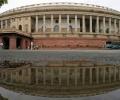
The Financial Sector Legislative Reforms Commission had in a report last year proposed a unified regulator for the entire financial sector -- markets, insurance, commodities and pension. It had, however, proposed to keep banking out of its purview for now.

The year 2014-15 could well go as one of long-pending financial sector reforms, expected to have a lasting impact.

The central bank has vehemently opposed the proposal, citing different reasons, including lack of focus and unconvincing results abroad.

The three main regulators have different approaches to grievance redressal and different standards to stop harmful from coming pitched at the consumer.

The government plans to set up a commission to reform the financial sector laws and institute an independent evaluation office among others, to bring about more transparency and public accountability.

The government-appointed Financial Sector Legislative Reforms Commission (FSLRC) has recommended a slew of reforms to overhaul the sector.
RBI Governor Raghuram Rajan had set up a committee to review the monetary policy framework.

Finance Minister P Chidambaram on Monday slammed "unregulated" players in the financial market saying their activities have adversely impacted large number of consumers.

After the last Budget's announcement of a major tax relief for those earning an annual salary of less than Rs 12 lakh, there is not much that individuals can look forward to in the forthcoming Budget, points out A K Bhattacharya.

In September 2013, FMC was brought under the Finance Ministry.

The exemption of individual life and health insurance premiums from the Goods and Services Tax (GST) enables the insurance industry to make products affordable and attractive, said Ajay Seth, chairman of Insurance Regulatory and Development Authority of India (Irdai) at the Business Standard BFSI Insight Summit 2025.

'The government is putting insurance in the same category as food, which is essential for life.' 'Now this is an opportunity for the sector to focus on the consumer.'

Three laws passed in Parliament could boost central revenues, reshape GST cess flows, shift MGNREGA costs to states and create new budget headroom ahead of the 2026-2027 Union Budget, points out A K Bhattacharya.

The Indian economy grew by 4.9 per cent in 2013-14 fiscal.

Exceptions were made for ultra-mega power plants, such as the one at Sasan, which the court observed were not under consideration, and for coal blocks attached to the power and steel companies controlled by the central government.

The bad loans of public sector banks were at 4.4 per cent in March 2014 compared with 2.09 per cent in 2008-09, it said, adding, the gross NPA increased by almost four times from March 2010 (Rs 59,972 crore or Rs 599.72 billion) to March 2014 (Rs 2,04,249 crore or Rs 2,042.49 billion).

DEA officials to push for this at a meeting with FM Jaitley.

The economic growth fell to a decade low of 5 per cent in 2012-13 fiscal.
.jpg)
Stating that there are strong inter-linkages between banks, NBFCs and other deposit-taking entities, he said for monetary policy to be effective and financial markets to remain stable, they should be regulated by the central bank.

The Sebi chief said that although the idea of an SRO has been challenged in court, he is hopeful of its implementation.
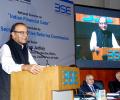
The government has proposed to implement GST from April 1, 2016, and the new Finance Commission may be set up ahead of its schedule to look into the issues related to the new indirect tax regime.

The proposed IFC disrupts existing regulatory structures.
The finance ministry has put out a revised draft in public domain.

'If there is an RBI majority in the committee, there is no question of a veto.'
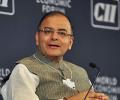
Pitching for greater transparency in rule-making and other functions of regulators, Finance Minister Arun Jaitley has asked Sebi to work towards attracting more retail investors to the capital markets.

India needs a place where all regulators could gather and function as in a war room.

FMC has been asked to go ahead with the appointment of 20 experts, which the commission had sought earlier.

Mergers and acquisitions would continue to create big corporate conglomerates but there is a need to draw a red line to avoid dominance and curbing of open competition in market by them, he said while addressing a conference on competition issues in New Delhi.

Of the eight RBI governors who have held office since the 1991 economic liberalisation, Bimal Jalan had the longest stint and S Venkitaramanan, the shortest. Current Governor Shaktikanta Das will overtake Bimal Jalan before completing his second term in December, points out Tamal Bandyopadhyay.

Report points out corporate vulnerability indicators remain elevated.

Many laws on the books are contradictory, and it is a truism that no Indian citizen or business can comply with every single law.
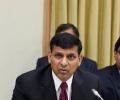
RBI data show one-fifth of all the infrastructure loans are stressed and the share of such loans in overall stressed assets is nearly a third.

US President Barack Obama on Sunday affirmed his commitment to enhancing India's 'voice and vote' in global financial institutions like IMF.

Policymakers should aspire to restore the pre-Independence environment where the rupee was trusted and used all over South Asia, in Southeast Asia, in West Asia, and in East Africa, suggests Ajay Shah.

Finance firms in these SEZs likely to get tax breaks.

Here are 15 things that would have made 2015 a great year.

The government is determined to stop generation of black money, he said.

Y H Malegam, 80, will head the panel that will look into non-performing bank assets and their relation to the Rs 114-bn PNB scam.
